

Restructured UR's onboarding flow around how people actually build trust with a new financial product rather than the compliance and engineering logic that shaped the original sequence.
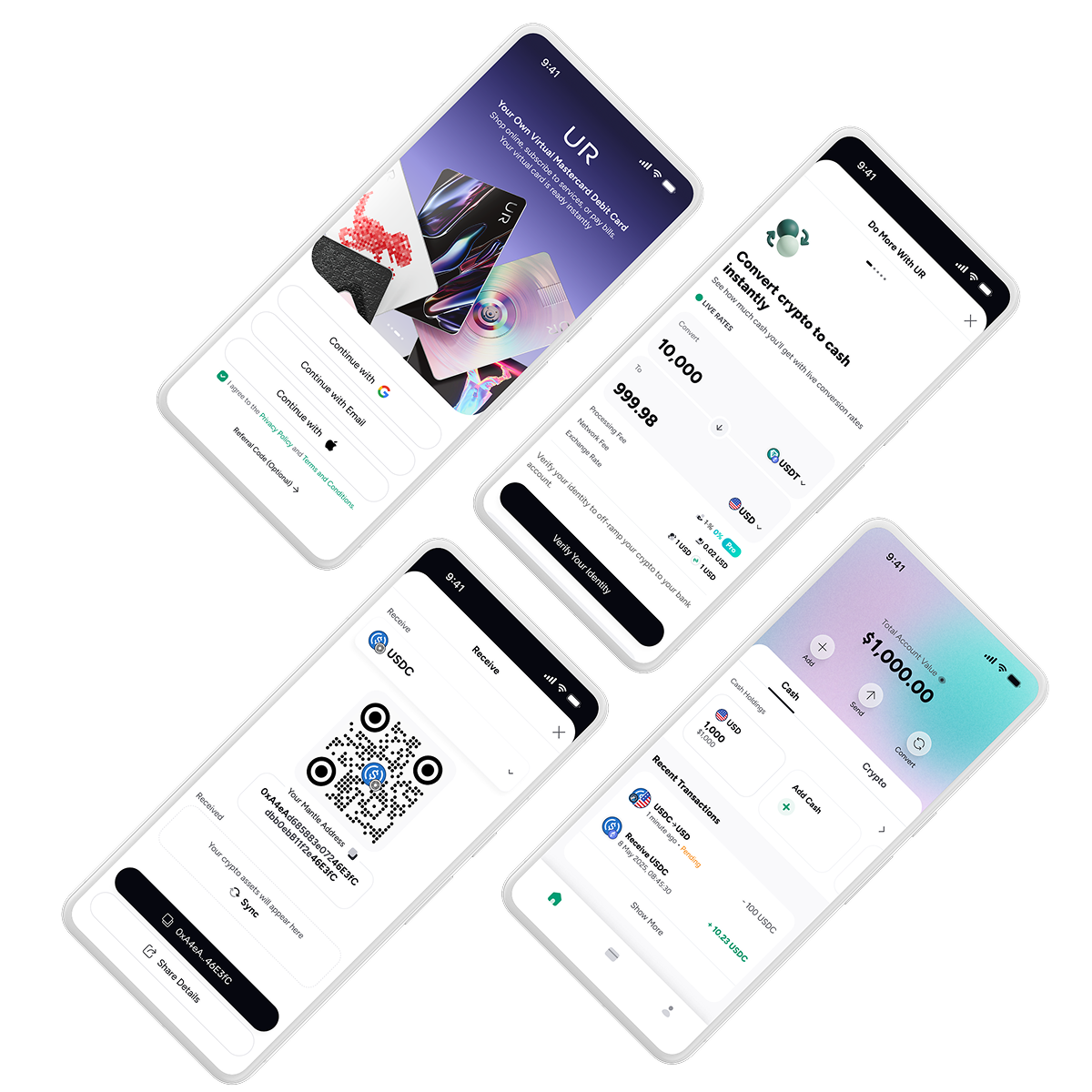
Only 32% of new users started KYC, and just 18% made a first deposit because the flow asked for commitment before showing any value. I ran a workshop to identify the right personas, mapped their emotional jobs, and restructured onboarding so users could explore the app and see live off-ramp rates before being asked to verify anything. KYC became something people walked into because they'd already seen the product work, not a gate they had to clear to find out if it was worth their time.
KYC start rate reached 89%, first deposit 72%.
UR is a crypto-first neobank built on Swiss banking infrastructure. Designed for people who hold crypto but struggle to use it in the real world. UR provides a real bank account with an IBAN, an off-ramp engine to convert crypto to multiple fiat currencies, and a Mastercard to spend it anywhere. Swiss regulation gave it legitimacy. The off-ramp was the product.
UR's onboarding followed a strict, linear sequence shaped almost entirely by compliance: download the app, sign up, then straight into KYC. Users who survived KYC were handed a wallet QR code and told to deposit before they could do anything else.

The result showed up in two numbers. Only 32% of people who minted the NFT ever started KYC, and of those who finished it, only 18% went on to make a first deposit.

The instinct inside the team was to treat this as a KYC drop-off problem . Simplify the form, reduce friction in the verification steps. Not wrong. BUT... the deeper issue was sequencing. We were asking people to commit to a stringent identity verification process and commit money before they'd seen a single reason the product was worth it.
Before touching any screens, I needed to understand who we were actually designing for and whether the assumed user flow matched the user we were trying to win.
I ran workshops with Product Managers, Developers and Designers to pressure-test who we were actually designing this product for. Building proto-personas, mapping empathy for each, and running jobs-to-be-done against the most relevant ones.

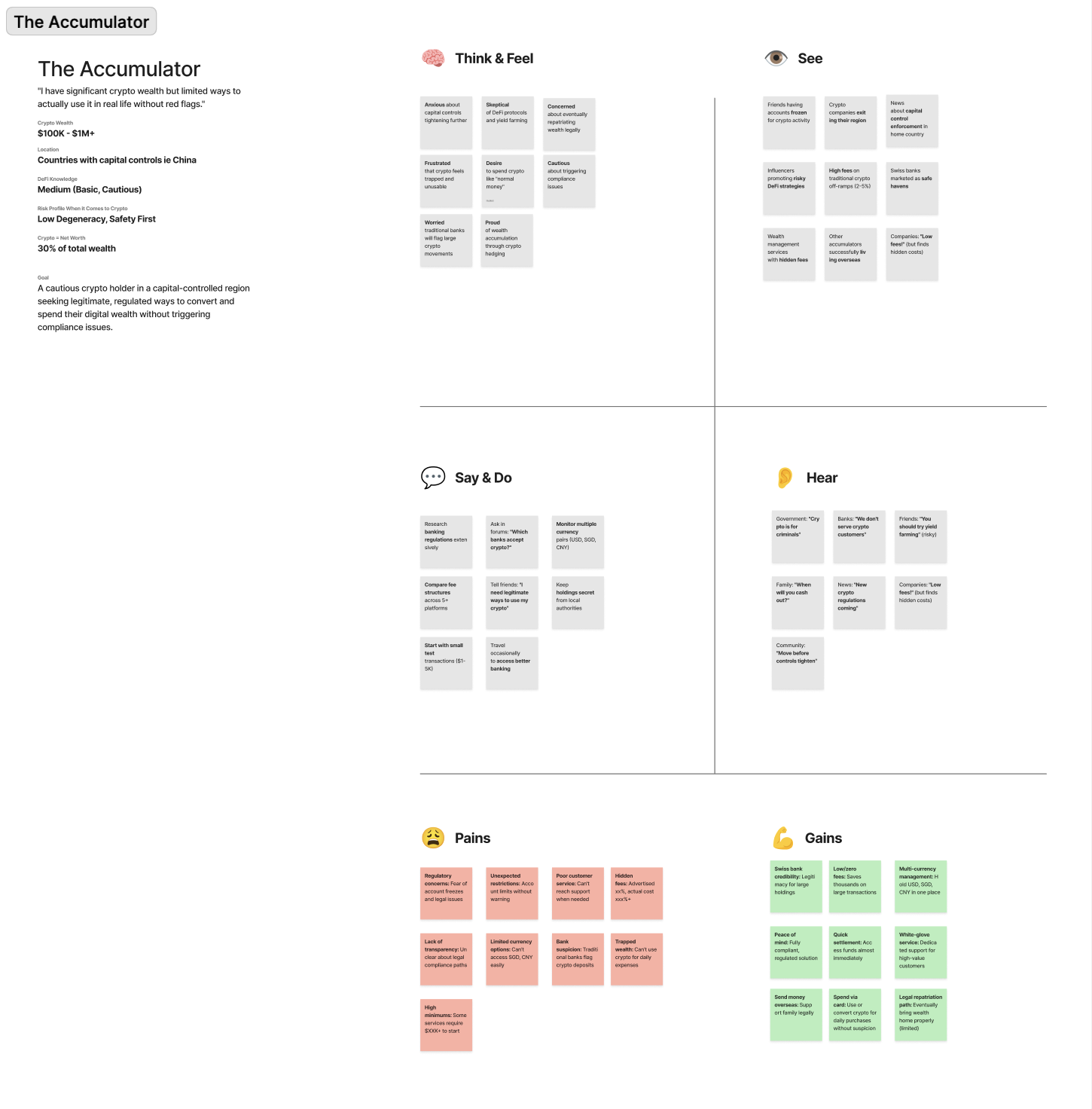

Running the workshop made the gap visible. The people most likely to use UR weren't DeFi natives who'd seen it all before. They were cautious, and unwilling to hand over identity documents or money to a product they hadn't yet seen work. The flow was designed for a user who didn't exist in the numbers we needed.
The initial solution was to gate off-ramp only after a threshold. Allowing users to off-ramp up to USD $500 without KYC, giving them a taste of the product before asking for commitment. Compliance pushed back. Strict regulatory requirements meant that wasn't viable.
When compliance said no, we stepped back and asked a more fundamental question. What does KYC actually produce? KYC produces an IBAN. And IBAN is what enables card spend, fiat off-ramp, and bank transfers.
.gif)
The answer was to let users in fully before asking for anything in return.


After signup, users landed directly on the dashboard and could explore the product freely. Nothing was hidden, nothing was locked behind a prompt to verify first. The gates only appeared at the moment a fiat-side feature was actually needed.

And users could deposit USDe and start earning APY before completing KYC at all giving value immediately. For the personas most motivated by returns and financial legitimacy, this was the moment the product stopped being a promise and started being proof.
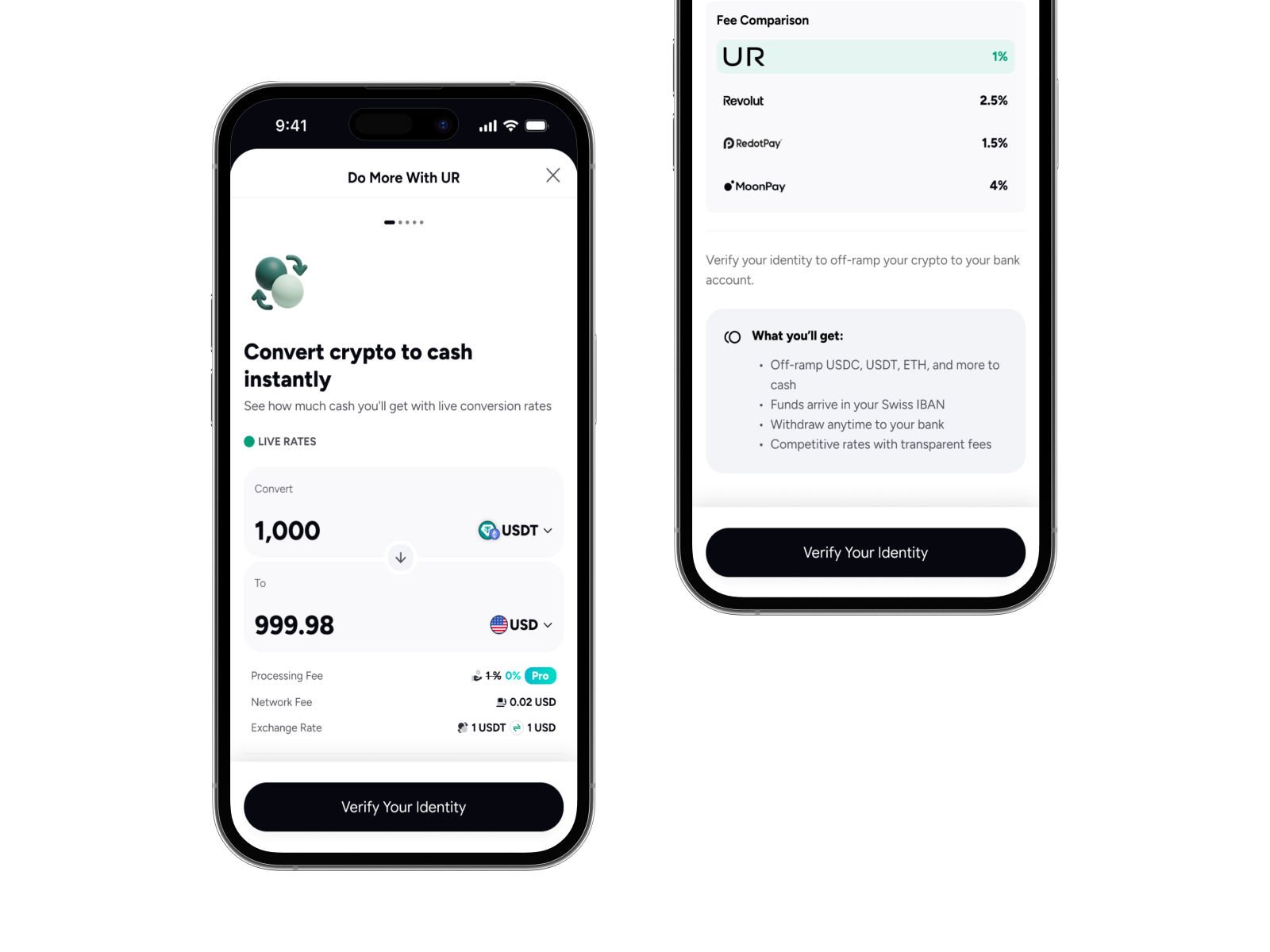
If users tried to off-ramp, they weren't blocked with a KYC wall. They were shown a live off-ramp calculator with real rates along with fees and competitors' fees. They could see exactly what they'd receive before committing to anything. The value proposition made itself.
KYC became the natural next step for a user who'd already decided they wanted in, rather than a gate standing between them and finding out.
Compliance defines the floor, not the sequence. The original flow treated compliance as a design constraint that couldn't be questioned and Reframing is what improved the onboarding. It the different understanding of what the flow was actually asking people to do, and when.
I sailed on an oil tanker at 19, became a cook and somehow ended up as a product designer. The through-line, if there is one, is that I've always been more interested in how things actually work than how they look like they work.
I build things with my hands when I'm not designing. It's taught me that good craft isn't about the visible surface, it's about the decisions underneath it that nobody ever sees but everyone feels.
I bring the same thinking to interfaces. Designs that are intentional, patterns that don't need to be relearned and conversations between people and machines that feel like they were thought through rather bolted on together.